
Thomson’s reading material (possibly)
Of Glasgow libraries

An earlier article looked at the publications held by the Glasgow Architectural Society – a predecessor to the Glasgow Institute of Architects – in a catalogue published in 1864. This one draws on 2003’s No Mean Society: 200 Years of the Royal Philosophical Society of Glasgow.
At the beginning of the 19th century, the only public library in Glasgow was Stirling’s Library, founded in 1791 by a bequest from Glasgow merchant Walter Stirling and housed in what must have been his recently completed home in Miller Street (below: Stirling’s bust, presumably commissioned when the Library opened, sits above the arched gateway).
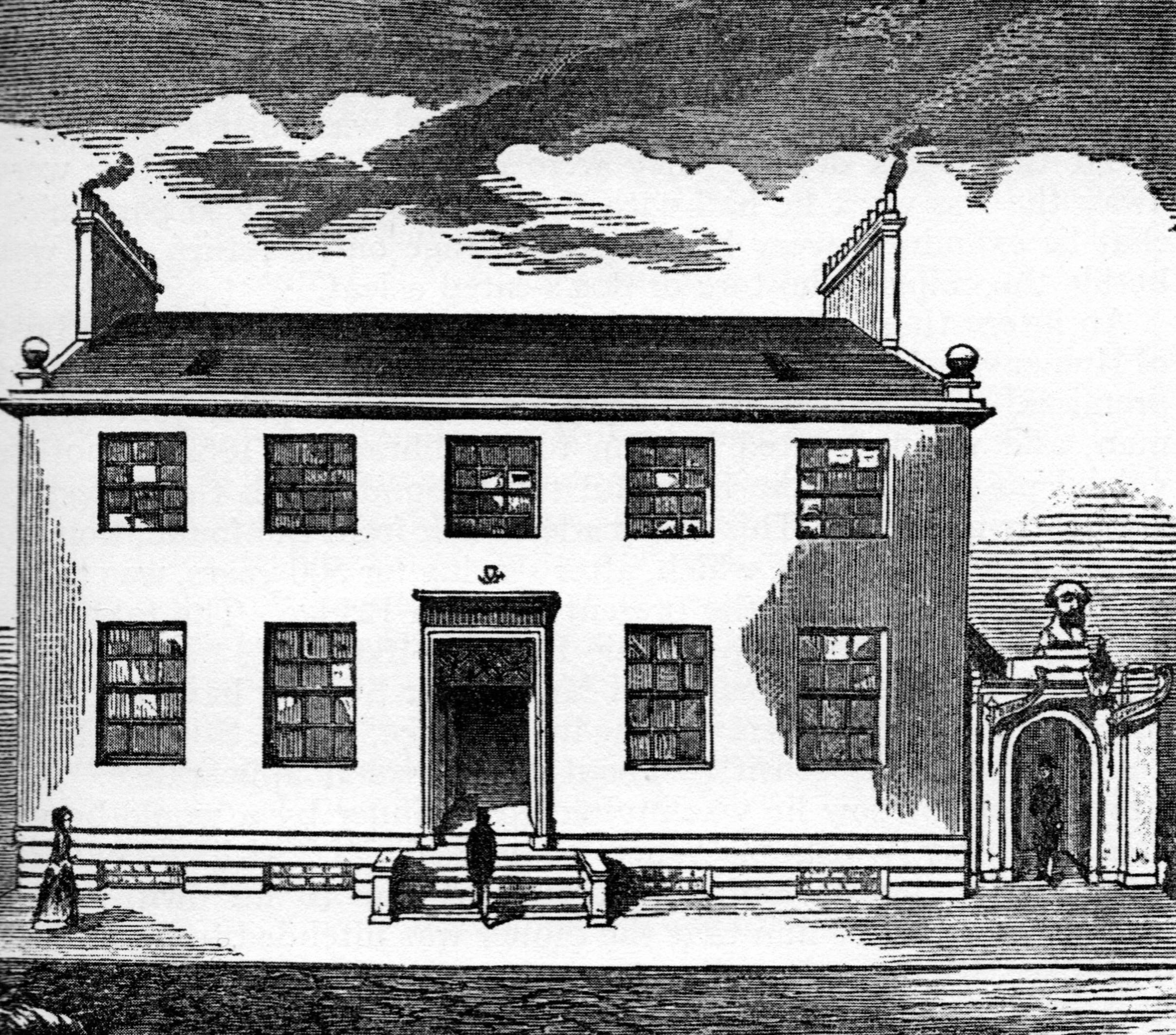
By 1801, Stirling’s Library had moved to the east side of St Enoch Square. In addition, there were the circulating libraries of bookseller Archibald Coubrough and Mrs Galloway, both based in the High Street, while bookseller and stationer John Smith offered a circulating library and reading room in Hutcheson Street, and there was a further reading room in the 2d [close] west from the New-wynd, presumably offering newspapers and periodicals, which would also have been available in the coffee houses of the city.
By 1805, the Glasgow Public Library was operating from Miller’s School in George Street, Stirling’s Library was now at architect David Hamilton’s recently opened Hutcheson’s Hospital in Ingram Street, and the two circulating libraries had been added to by one from W. Stark & Co. at 99 Glassford Street. Another source of information was the Philosophical Society’s new library, established by its vice-president John Robertson, who
purchased 71 arts and science journals while on a trip to London in 1803 and followed this with another consignment in 1804. By 1811 journals taken by the Society included The Philosophical journal, Retrospect and The Repertory (or to give it its full title: The Repertory of Arts and Manufactures consisting of Original Communications and Specifications of Patent Inventions and a Selection of Useful Practical Papers from the Philosophical Societies of All Nations etc., etc.).1
The problem was that although Stirling had willed a reference library with free access to the public, his bequest, comprising his house, a collection of 804 books, and £1,000 was proving inadequate to the task.
At the outset from 1802, the Society had sought to secure ‘a select library of scientific books’2 and it started well enough: in 1812, William Duncan became the first librarian and the Society’s Committee agreed to purchase Rees’ Cyclopaedia as each volume came out, the Encyclopaedia Britannica, being added later.
Each year, additions were made to the Library as funds allowed. The catalogue of 1829 had 300 volumes of which 69 volumes were a complete set of Repertory from 1794 and another 68 volumes were of the Philosophical Magazine from 1798. ‘General Works’ included Brewster’s Dictionary and Hedderwick’s Reference Book.3
But money remained an issue here too: by 1831 it had to reduce the money spent on adding to the library. Of the journals, only the Repertory was continued
since members involved in inventing new machinery and improvements to processes and parts of machines… looked to patenting those with financial prospects and hence the need for Repertory and up-to-date scientific journals.4
In 1831, the short term answer was to have the Society’s library taken into the Andersonian Institution’s Library. Nine years later, the Society was able to pay £45 to take 500 books and journals held there, many presumably being from the Society’s earlier library.
By 1845 the total number of books was 750 miscellaneous volumes and 550 journals. In 1853, the total had risen to over 2,000 volumes… By 1869 the total was 4,831 volumes and the Library was insured for £2,000. In December of that year, when the Architectural Society amalgamated, their books were added to the Library.5
The Glasgow Architectural Society
Professionalisation, including through the formation of institutions bringing together practitioners in different fields, was a theme of the early 19th century, although preceded by some years in such fields as medicine. Among architects in Glasgow, a probably informal body had existed at the turn of the century, since Charles Wilson later reported
At the meetings of that association there used to be Peter Nicholson, David Hamilton, William Hamilton – the architect of the Tontine Exchange and Hotel – Deacon Craig, or Bailie Craig, and one or two more. And I remember Mr. Hamilton telling me that when Peter Nicholson produced a drawing of a Doric column, wanting the base, its stunted dimensions excited the laughter of the members, accustomed as they were to Roman architecture, having heard almost nothing about Grecian architecture.6
In 1840, the Institute of Architects in Scotland (IAS) was established as a counterpart to the foundation six years earlier of the Institute of British Architects (later the RIBA), but within a decade, internal politics had led to its collapse and replacement in 1850 by the Architectural Institute of Scotland, which
attracted virtually all the leading architects in Edinburgh and Glasgow and included lay members (i.e. clients) and associate members (related professors, decorators and tradesmen).7
The Institute focused on practising architects for its members, but the following year, in October 1851, the Glasgow Architectural Association held an introductory soiree for its members, ‘draughtsmen and pupils in the various architects’ offices in the city’, at which its President, James Boucher spoke, together his later business partner James Cousland, and Robert Macfarlane. A month later, Charles Wilson (with whom Boucher and Cousland had both been articled), James Smith, and John T Rochead contributed prize money, while Thomas Gildard later donated a copy of one of his publications.8
By 1858, however, Glasgow members of the Institute were concerned that it was too Edinburgh-orientated: all the Institute’s books, casts and drawings were stored there. nor did any Glasgow members of the Institute have the freedom to make any purchases without agreement from Edinburgh. The result was the formation of the Glasgow Architectural Society on 25 January 1858 in the Thomson-designed Scottish Exhibition Rooms in Bath Street. How much Thomson was involved in the Association isn’t known, but he took an active part in the Society, becoming its Chairman later.
One object of the Society was to establish a library in Glasgow that would open to draughtsmen and apprentices as well as to principals.
The Glasgow Architectural Society Library
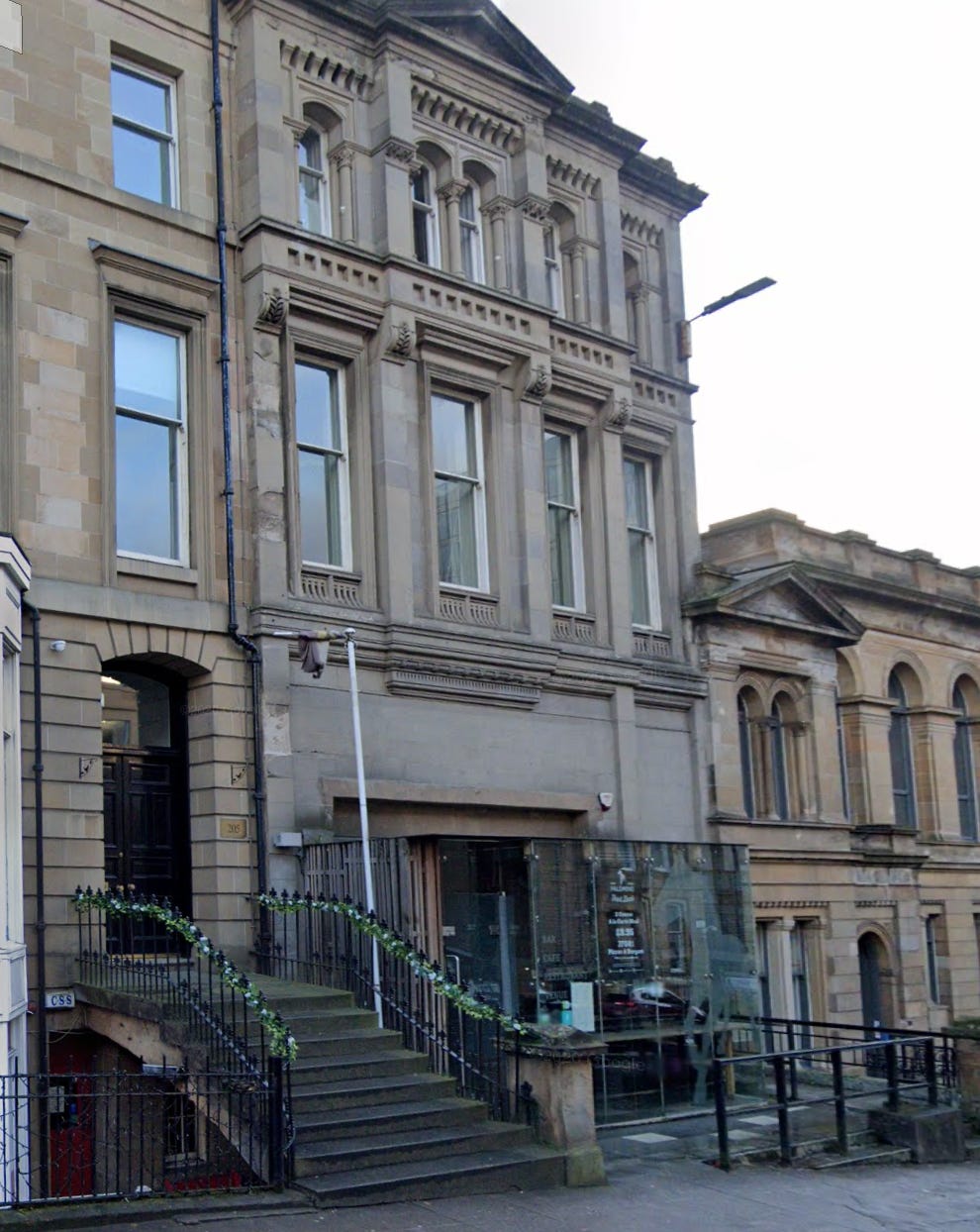
The Society would continue into the 20th century, but in December 1869 its library was added to that of the Royal Philosophical Society, at a point at which its library totalled 4,831 volumes, insured for £2,000. By 1903, with the Royal Philosophical Society ensconced in its 1880 purpose-built headquarters at 207 Bath Street with its own library, the insurance value had risen to £4,900, with an additional £500 for the books in the ‘Architectural Section’, both figures no doubt allowing for additional purchases since 1869.
In 1947-48, some books (presumably duplicates) were sold for £750, and when the headquarters building was sold in 1961, the libraries were housed temporarily in the Mitchell Library and back at the Andersonian Library in the Royal Technical College. In 1968-69 the libraries were sold off, the Andersonian Library paying £300 for a selection, with the rest sold by Thin’s in Edinburgh (raising £500) and Sotheby’s in London (raising £4,564). We don’t know where these books ended up (although the Society’s copy of James Cleland’s 1813 A description of the manner of improving the green of Glasgow… ended up in the University of California….
The Library in 1908
The following catalogue of books in the Royal Philosophical Society includes a separate entry for the Architectural Section. The Society’s own books include some on architecture, building and design, not shown here, such as The Builder and Building News and Engineering Journal, both from 1870, and British Architect and Northern Engineer from 1874. Those shown in bold represent books published before 1875, and therefore accessible to Thomson and his office, although the later ones might not have been purchased by or gifted to the Glasgow Architectural Society by the time of Thomson’s death in March 1875.
What is remarkable is the large percentage of entries that pre-date 1875, with relatively few volumes added over the following thirty years. Perhaps it was a combination of increasing numbers of architectural practices purchasing their own copies rather than journeying to Bath Street to consult a volume, greater access to the city’s public libraries, or lack of funds by the Society for book purchases. We know that Alexander and George Thomson had books of their own (although precisely which remains open to further research). How much use they made of the GAS library isn’t known.
Note:
For brevity, subject entries that duplicate an actual work or author have been removed. Where ‘N.D.’ is given for the publication date, these have been sourced or approximated, where possible.
Air, Uses and abuses of; by J. H. Griscom. 1850.
Allen, C. B. Cottage building for the labouring classes. 1849-50.
Anderson, W. J.
– Architectural studies in Italy. Fol. 1890.
– The architecture of the Renaissance in Italy. 1896.
Architect, The, and Building Operative. 2 v., fol. 1849-50.
Architects, Royal Institute of British.
– Transactions. 1839 and 1862-71. 6 v., 4° (1 bound, others in parts).
– Catalogue of library. 4°. 1865.
Architectural Institute of Scotland. Transactions. 2 v. 1851-54.
Architectural Magazine and Journal. Vol. 4. 1837.
Architectural Publication Society. 12 parts, fol. 1848-52.
Architecture. Quarterly papers on architecture. 4 v., 4°. 1844-55.
Architecture Moderne (no title-page). Illustrations of plans, elevations, &c. Published by Grim. Fol. N.D. [possibly a later edition of Charles Etienne Briseux, 1728–29]
Arrowsmith, H. W., and A. The house decorator. 4°. 1840.
Art Journal.
– 11 v., 4°. 1849-59.
– Exhibition catalogues: London, 1851; Dublin, 1853; Paris, 1851 in one Vol. 4°.
Arts. The Pictorial Gallery of Arts. Fine Arts. Vol. 2, fol. 1847.
Art Union. Vols. 9-10. 4°. 1847-48.
Ballantine, James. Treatise on painted glass. 1845.
Barry, Charles.
– New Palace of Westminster. 4°. 1849.
– The Travellers’ Club House. Fol. 1819.
Bartholomew, Alfred. Specifications for practical architecture. 1841.
Billings, R. W.
– Baronial and ecclesiastical antiquities of Scotland. 4 v., 4°. 1845-52.
– Geometric tracery of Carlisle Cathedral and of Brancepeth Church. 2 vols. in 1. 4°. 1842-45.
– Illustrations of Carlisle Cathedral. 4°. 1839.
– Architectural illustrations of Carlisle Cathedral. 4°. 1840.
– Durham Cathedral. 4°. 1843.
– Architectural antiquities of the county of Durham. 4°. 1847.
– The power of form applied to geometric tracery. 1851.
– The infinity of geometric design exemplified. 4°. 1849.
– Architectural illustrations of Kettering Church. 4°. 1843.
– Illustrations of the Temple Church, London. 4°. 1838.
Bowman, H., and Crowther, J. S. Churches of the Middle Ages. 2 v., fol. N.D. [likely 1853]
British Home of To-day, The. Edited by W. S. Sparrow. 1904.
Britton, John.
– Architectural antiquities of Great Britain. 5 v., 4°. 1835.
– History of the Metropolitan Church of Canterbury. 4°. 1836.
– History of the Cathedral Church of Salisbury. 4°. 1836.
– and Pugin, A. Public buildings in London; with supplementary volume, by W. H. Leeds. 3 vols. 1825-38.
Britton, T. A. A treatise on dry rot in timber. 1875.
Brooks, S. H. Designs for public buildings. 4°. 1842.
Bruff, Peter. Treatise on engineering field-work. 1846.
Brunton, Robert. A compendium of mechanics. 1837.
Buchanan, M. S. History of Glasgow RoyaI Infirmary. 4°. 1832.
Building Chronicle. Vol. 1. 4°. N.D. [but pre-1856]
Building News. Vols. 3 to 8. 6 v., 4°. 1857-62.
Burnett, Sir William. Patent process for the preservation of timber, canvas, &c., from dry rot, &c. N.D. [ca 1840]
Calliat, Victor.
– Hôtel de Ville de Paris. Fol. N.D. [likely 1864]
– Parallèle des maisons de Paris. Fol. 1850.
Chambers, Sir William. Civil architecture, with notes by Papworth. Fol. 1836.
Chevreul, M. E. Harmony and contrast of colours. 1855.
Christian, Eugene. Skelton Church, Yorkshire. 4°. 1846.
Civil Engineer and Architect’s Journal. 13 v., 4°. 1837-50.
Collie, J.
– Plans, elevations, sections, details, and views of the Cathedral of Glasgow. Fol. 1839.
– Linlithgow Palace. Fol. N.D. [probably 1830]
Coney, John. Ancient cathedrals and other public buildings in France, Holland, &c. Fol. 1832.
Connell, Isaac. Law affecting building operations and architects’ and builders’ contracts. 1903.
Cook, A. G. The New Builder’s Magazine and Complete Architectural Library. 4°. 1819.
Cunningham, Allan. Lives of the British painters. 6 v. 1830.
Cuthbertson, T. W. Sketch of St. George’s Parish Church, Glasgow. 1894.
Davy, C. Architectural precedents. 1841.
Desgodetz, Antony. The ancient buildings of Rome. 2 v., fol. 1871.
Dictionary of architecture. Published by the Architectural Society. 23 parts letterpress, and 8 parts illustrations. Fol. 1848-92.
Didron, M. Christian iconography. Vol. 1. 1851.
Dollman and Jobbins. Ancient domestic architecture in Great Britain. 2 v., 4°. N.D. [1861]
Donaldson, T. L.
– Architectural maxims and theorems. 1847.
–Architectura numismatica.1859.
Douglas, George. The art of drawing in perspective. 1805.
Dublin, Historical guide to. 1825.
Ecclesiastical architecture of Scotland; by Macgibbon and Ross. 3 v. 1896-97.
Edinburgh Architectural Association. Sketch Book. New series. Vol. 1, fol. 1883-86.
Elmes, James.
– Dictionary of the Fine Arts. 8 v. 1826.
– London in the nineteenth century. 2 v., 4°. 1827..
Faulkner, T.
– Designs for monuments, &c. 4°. 1835.
– Designs for shop-fronts, &c. 4°. N.D. [probably 1831]
Fréart, Roland. A. parallel of architecture. Fol. N.D. [originally 1650]
Ferguson, James. The art of drawing in perspective made easy. 1810.
Field, George. Chromatography. 4°. 1835.
Fillans, James, Memoir of; by James Paterson. 4°. 1854.
Flaxman, John. Classical designs Homer (2 v.), Aeschylus, and Hesiod. 4 v., fol. N.D. [pre-1826]
Fletcher, B. and B. F. A history of architecture on the comparative method. 1901.
Gandy and Baud. Architectural illustrations of Windsor Castle. Fol. 1842.
Gau, F. C. Antiquites de la Nubie. Fol. 1822.
Gell, Sir William. Pompeiana: topography, edifices, and ornaments of Pompeii. 2 v. 1832.
Gibbs, James. Architecture; designs of buildings and ornaments. Fol. 1739.
Gibbs, John.
– English Gothic architecture. Fol. 1855.
– Designs for Gothic ornaments. Vol. 1. 1853.
Glasgow Architectural Association. Sketch Book. 3 v. 4°. 1885-88.
Glasgow Mechanics’ Magazine.
– Vols. 3 to 5. 1825-26.
– Vol. 4. 1826.
Glasgow Royal Philosophical Society, Constitution of. 1850.
Goodwin, Francis. Domestic architecture. 2 v. (2 copies), 4°. 1833-34.
Goodwin, George, jun. The Churches of London. 2 v. 1838.
GORDON J. F. S. Ancient and modern Glasgow. Edited by J. F. S. Gordon. 2 v. 1872.
Gourlay, R. F. The Mound Improvement. 1850.
Griscom, J. H. Uses and abuses of air. 1850.
Gruner, Lewis.
– Fresco decorations and stuccoes of churches and palaces in Italy. 2 v., fol. and 4°. 1854.
– Specimens of ornamental art from models of the classical epochs. Fol. 1850.
– Ornamental art, text and additional plates. 4°. 1850.
Gwilt, Joseph.
- Beauty in Grecian architecture. 4°. N.D. [probably 1825]
– Rudiments of architecture. 1826.
– The architecture of Marcus Vitruvius Pollio. 4°. 1826.
Hamilton, David. Original sketched designs. 3 v., fol. N.D. [bef 1843]
Hamilton, Sir Wm. Greek vases. 2 v., fol. 1781.
Haselden and Company. Catalogue of designs in papier maché for interior decorations. 4°. N.D.
Hay, D. R.
- Harmonic law of nature. 1855.
·- Harmony of form. 4°. 1842.
-- Laws of harmonious colouring. Fourth edition. 1838.
-- Laws of harmonious colouring. Fifth edition. 1844.
-- Orthographic beauty of the Parthenon. 1853.
-- Proportion, or the geometric principle of beauty analysed. 4°. 1843.
Hebert, Luke. Treatise on railroads. 1837.
Hope, Thomas. Historical essay on architecture. 2 v. 1840.
Hunt, T. F. Exemplars of Tudor architecture. 4°. 1830.
Ingram, James. Memorials of Oxford. 3 v. 1837.
Jameson, Robert. Mineralogy. 1837.
Jebb, J. Modem prisons: their construction and ventilation. 4°. 1844.
Jones, Owen. Grammar of ornament. Fol. N.D [probably 1856].
Kendall, H. E. Kensal Green Cemetery chapel and gateways. Fol. 1832.
King, T. Cabinet work. 4°. N.D. [probably Thomas King, The Modern Style of Cabinet Work Exemplified, 1829]
Kleuze, L. Von. Architektonischer Entwürfe. Fol. 1830.
Knight, F. Scroll ornaments for silversmiths, chasers, and die-sinkers. 4° N.D. [probably 1833]
Landon, C. P. Vies et oeuvres des peintres le plus célèbres. 17 v., 4°. 1803–13.
Langley, Batty. Architecture (no title-page). 4°. N.D. [pre-1750]
Layard, A. H. Discoveries of Nineveh. 1851.
Lenormant, Charles. Antiquités Egyptiennes. Fol. 1841.
Leslie, John. Guide to surveying. 1806.
Letarouilly, P.
– Edifices de Rome moderne. 3 v., fol. 1843.
– Edifices de Rome moderne. 4°. 1849.
Loudon, T. C. Encyclopaedia of cottage, farm, and villa architecture. 1839.
Macgibbon and Ross.
– Castellated and domestic architecture of Scotland. 5 vols. 1887-92.
– Ecclesiastical architecture of Scotland. 3 v. 1896-97.
Mackenzie, Frederick. Architectural antiquities of St. Stephen’s Church, Westminster. Fol. 1844.
McLellan, A. Cathedral Church of Glasgow. 4°. 1833.
McWilliam, Robert. Origin and operation of dry rot. 4°. 1818.
Mahan, D. H. Civil engineering, edited by Professor Barlow. 4°. 1838.
Mechanic and Engineer’s Magazine. 2 v., 4°. 1842-43.
Moller, George. Essay on Gothic architecture. 1824.
Munch, and Schirmer. Throndheim’s Domkirke. Fol. 1859.
Mylne, Rev. R. S. The master masons to the Crown of Scotland. Fol. 1893.
Nicholson, Peter.
– Dictionary of architecture; vol. 1, edited by Lomax and Gunyon. 4°. N.D. [probably 1862]
– Principles of architecture. 3 v. 1809.
– New practical builder. 4°. 1823.
– – Another copy. 2 v.
Normand Fils. Monumens funeraires de Paris, &c. Fol. 1832.
Northern Architectural Association. Proceedings. 1860-61.
Pagan, James. History of Glasgow. 1847.
Palestine and Egypt. A companion to Seaton’s map. 1838.
Palladio, A.
– Architecture. 2 v. in 1. Fol. 1721.
– Architecture. Fol. 1838
Parker, Charles
– Villa rustica. 4°. 1833.
– Villa rustica. 4°. 1848.
Peel Banquet. Illustrations of the Pavilion. 4°. 1837.
Prior, Edward S. A history of Gothic art in England. 1900.
Pugin, A.
– Gothic architecture in England. 2 v., 4°. 1831.
– Gothic architecture in England. 2 vols., 4°. N.D.
– and Heath. Paris and its environs. 4°. N.D.
– and Willson. Specimens of Gothic architecture. 2 v., 4°. 1821.
Racinet, M. A. L’ornement polychrome. 2 v., fol.. 1873.
Reid, D. B. Theory and practice of ventilation. 1844.
Reid, Hugo. The steam-engine. 1840.
Reports and papers of the architectural societies of Northampton, York, Lincoln, and Bedford. 1852-53.
Richardson, Charles J.
– Elizabethan architecture. 4°. 1837.
– Treatise on warming and ventilation. 1856.
Rickman, Thomas. Architecture in England. N.D. [likely ‘An Attempt to Discriminate the Styles of English Architecture from the Conquest to the Reformation’, 1817]
Robinson, P. F.
– Rural architecture. 4°. 1828.
– Plans, elevations, &c., of Woburn Abbey, and of Hatfield House. 2 v. in 1, fol. 1833.
– Designs for ornamental villas. 4°. 1836.
Robson, E. R. School architecture. 1874.
Rondelet, Jean. Traité théorique et pratique de l’art de bâtir. 5 v., 4°. 1830.
Rosslyn chapel, Historical and descriptive account of. 1827.
St. John’s Parish Church, Glasgow, History of. 4°. 1877.
Schinkel, C. F. Architektonischer Entwürfe. Vol. 2, fol. N.D. [probably before 1840]
“Senex.” Glasgow, past and present. 3 v. 1851-56.
Sharpe, Edmund.
– Architectural Parallels. 2 v., fol. 1848.
– Supplement to “Architectural Parallels.” Fol. 1848.
– Decorated window tracery in England. 2 v. 1849.
Shaw, Henry.
– History and antiquities of Luton Park Chapel. Fol. 1829.
– Ornamental metal work. 4°. 1836.
Shaw, Norman. Architectural sketches from the Continent. Fol. N.D. [probably 1872]
Shotts Iron Company. Catalogue. 4°. N.D.
Soane, John. Designs in architecture. N.D.
Stark William. Remarks on the construction of public hospitals. 4°. 1807.
Strang, John. Glasgow and its clubs. 1856.
Street, G. E. Brick and marble architecture in Italy. 1855.
Stuart and Revett. Antiquities of Athens. Vols. 2, 3, and 4. Fol. 1787-94, 1816.
Sutcliffe G. L. The modern carpenter, joiner, and cabinetmaker. 8 v. 1902-1904.
Tatham C. H. Grecian and Roman architectural ornament. Fol. 1826.
Taylor G. L., and Crecy, E. The architectural antiquities of Rome. 2 v., fol. 1821.
Texier, Charles, and Pullan, R.P. Byzantine architecture. Fol. N.D. [probably 1864]
Thomson, J. Retreats: designs for cottages, villas, and ornamental buildings. 4°. 1840.
Tredgold, Thomas.
– Elementary principles of carpentry. Edited by Barlow. 4°. 1840.
– Strength of cast iron and other metals. 1824.
Trendall, E. W. Cottages and villas. 4°. N.D. [probably 1831]
Venice. Descrizione della I. R. Basilica di S. Marco. Fol. N.D.
Vicat, L. J. Mortars and cements: translated by Smith. 1837.
Vulliamy, Lewis. Examples of ornamental sculpture in architecture. Fol. N.D. [probably 1827]
Walker, W. Hints on ventilation. 1850.
Wallis, N. The carpenter’s treasure; designs for temples, gates, &c., in the Gothic taste. N.D. [probably 1773]
Waring, J. B. The arts connected with architecture in Central Italy. Fol. 1858.
Watson and Pritchett. Plans, elevations, &c., of Wakefield Asylum. Fol. 1819.
Watson, T. L. The double choir of Glasgow Cathedral; a study of rib vaulting. 1901.
Weale, John. Ornamental gates, lodges, palisading, and rails of the Royal Parks. 2 parts, fol. 1839-41.
White, John. Rural architecture. 4°, 1845.
Wickes, Charles. Spires and towers of the mediaeval churches of England, 3 v., fol. 1853-59.
Winkle’s Cathedrals of England and Wales. Vol. 1. 1838.
Woods, Joseph. Letters of an. architect from France, Italy, and Greece. 2 v.’ 4°. 1828.
Wyatt, M. Digby.
– The industrial art of the nineteenth century. Fol. 1851.
– The art of illuminating. 4°. 1860.
Young, C. D. Treatise on wire fencing. 1850.
Zahn, William. Ornamente aller klassischen Kunst Epochen. 20 parts, fol. 1870.
Zinc, Application of, for roofing, &c. F. Braby & Co. 1869.
Borowski, No Mean Society: 200 Years of the Royal Philosophical Society of Glasgow, Glasgow 2003
Glasgow Herald, 4 Nov 1880
Borowski, op. cit.
ibid.
ibid.
Scottish Guardian, 5 Mar 1858
Online Directory of Scottish Architects
Glasgow Gazette, 11 Oct 1851; Glasgow Chronicle, 5 Nov 1851
Always fascinating! My lunch-hours are taken up with walks to mentioned building's, my own office being Abbey House Bothwell St.