
Borrowed knowledge: ‘The arch never sleeps’
What ‘Greek’ Thomson learned from Fergusson, and from experience?

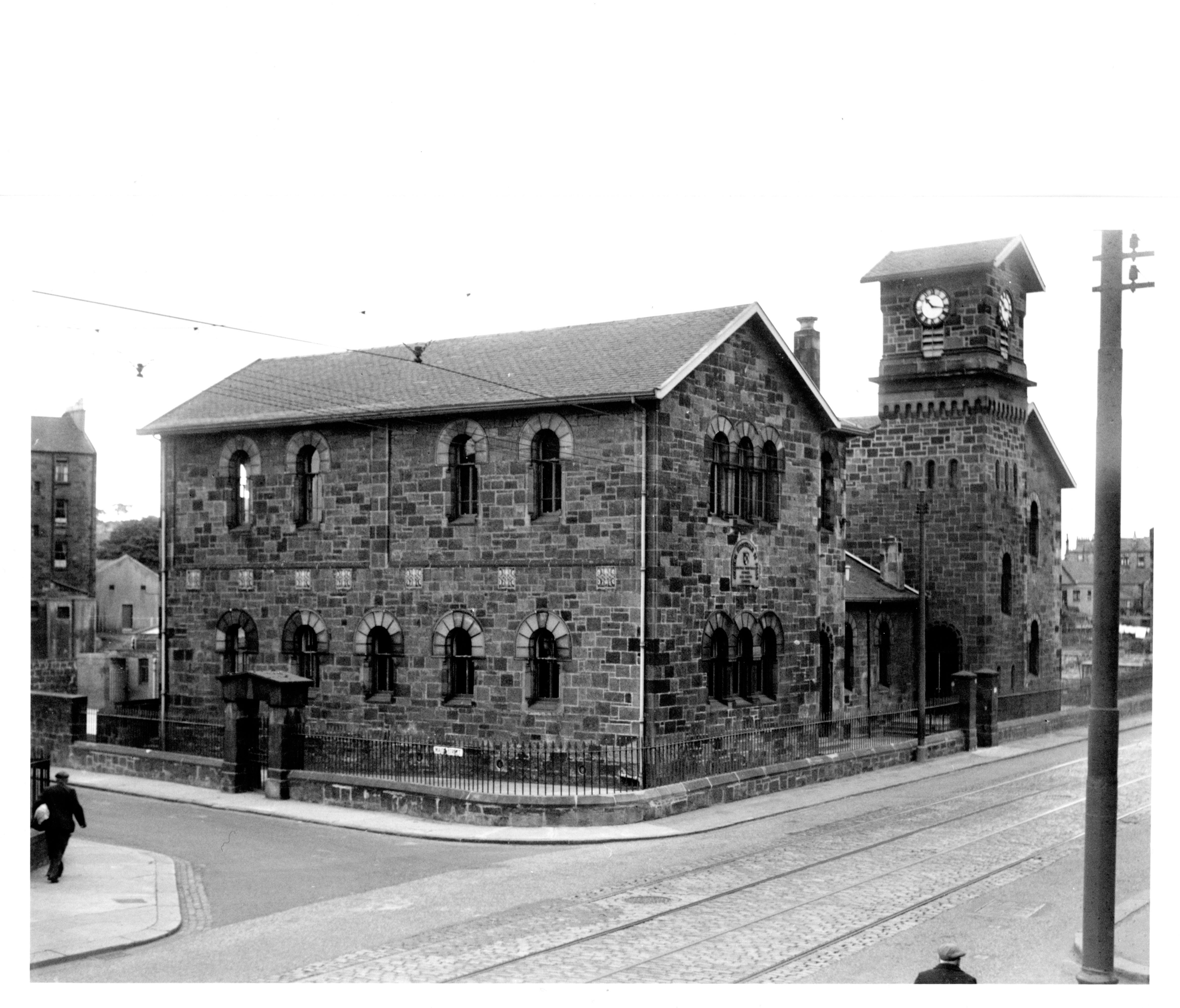
An often-quoted statement from ‘Greek’ Thomson’s Haldane Lectures of 1874 is “the arch never sleeps”, usually accompanied by a second statement that sometime during Thomson’s career an arch of his had failed, thus putting him off its future use in his designs.
Thomson’s statement, a quotation, comes in the last of his lectures On Art and Architecture, ‘On Roman Architecture’:
Mr. Fergusson tells us that the Hindoos say, “the arch never sleeps” and, although the Mahommedans of India use it frequently, the Hindoos avoid it altogether.
In a footnote, Gavin Stamp writes:
James Fergusson, on page xxxv of his Illustrated Handbook of Architecture, 1855, wrote of the Hindus that, “As they quaintly express it, ‘An arch never sleeps,’ and it is true that by its thrust and pressure it is always tending to tear a building to pieces; in spite of all counterpoises, whenever the smallest damage is done, it hastens the ruin of a building, which, if more simply constructed, might last for ages.” – a lesson which Thomson clearly took to heart.1
We do not know if Thomson had his own copy of Fergusson. Two volumes of the three-volume A History of Architecture in all Countries from the Earliest Times to the Present Day from 1867 are listed in the Architecture and Fine Arts Section of the library of the Glasgow Architectural Society, of which Thomson was a member (Fergusson had combined his 1855 work with his 1862 A History of the Modern Styles of Architecture, recast and published during 1865-7). Thomson must have seen this or an equivalent volume, since he refers to the illustration of ‘Dêr-el-Bahri’ (below), which only appears from the later work.
The context for Fergusson’s comment is a section in his Introduction on Construction:
Construction has been shown to be the chief aim and object of the engineer; with him it is all in all, and to construct scientifically and at the same time economically is the beginning and end of his endeavours. It is far otherwise with the architect. Construction ought to be his handmaid, useful to assist him in carrying out his design, but never his mistress, controlling him in the execution of that which he would otherwise think expedient. An architect ought always to allow himself such a margin of strength that he may disregard or play with his construction, and in nine cases out of ten the money spent in obtaining this solidity will be more effective architecturally than twice the amount expended on ornament, however elegant or appropriate that may be.
So convinced were the Egyptians and Greeks of this principle, that they never used any other constructive expedient than a perpendicular wall or prop, supporting a horizontal beam; and half the satisfactory effect of their buildings arises from their adhering to this simple though expensive mode of construction. They were perfectly acquainted with the use of the arch and its properties, but they knew that its employment would introduce complexity and confusion into their designs, and therefore they wisely rejected it.2
Fergusson goes on to explain how the Romans ‘were the first who introduced a more complicated style’, which Thomson uses as the basis to take up a significant part of his lecture: more than a quarter of his 9,700-word lecture focuses on the arch. Before then, however, in a section headed ‘Invention of the Arch’ in relation to Egyptian Architecture, Fergusson notes that
many of the tombs and chambers around the pyramids are roofed by stone arches of a semicircular form, and perfect in every respect as far as the principles of the arch are concerned.


Fergusson admits that his argument about the earliest date for evidence of arches is hampered by lack of information from the source for his drawings: ‘Several of these have been drawn by Lepsius3, and are engraved in his work, but, as no text accompanies them, and the drawings are not on a sufficient scale to make out the hieroglyphics, where any exist, their date cannot now be ascertained.
The so-called Treasuries of Mycenae and Orchomenos, as well as the chambers in Etruscan tombs, prove that as early as ten or twelve centuries before Christ the Pelasgic races had learned the art of roofing circular chambers with stone vaults, not constructed, it is true, as we construct them, with radiating vaults, on the principle of the common arch, but by successive layers of stones converging to a point, and closed by one large stone at the apex.
The Roman arch and Roman dome are always constructed on the principle of voussoirs, or truncated wedges, radiating from a centre. This enabled the Romans to cover much larger spaces with their domes than perhaps was possible on the horizontal principle; but it involved the inconvenience of great lateral thrusts, continually tending to split the dome and tear the building in pieces, requiring consequently immense and massive abutments to counteract their destructive energy. This class of dome was entirely overlooked or rejected by the Gothic architects, but was taken up by the contemporary Byzantines, and made by them the principal feature of their architecture, and from them passed to the Saracenic architects, who also adopted it as their most important mode of architectural expression.
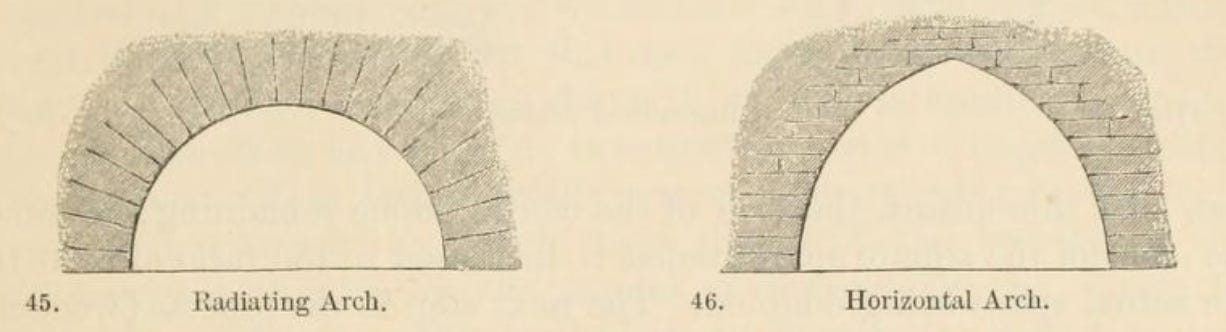
In a section on Domes, Fergusson distinguishes between the ‘horizontal arch’ and the ‘radiating arch’ (above), noting that
The Indian or horizontal dome never can be made circular in section, except when used on the smallest scale, but almost always takes a form more or less pointed. From the time of the building of the Treasury of Mycenae to the birth of Christ we have a tolerably complete series of arches and vaults constructed on this principle, but few domes properly so called. After the Christian era the first example is found in a singular tomb at Mylassa near Halicarnassus, where it exhibits all the peculiarities of construction found in the Jaina temples of India.
Thomson sees an abiding difference between Greek and Roman culture being that, while for the Greeks “the gods see everywhere”, the Romans instead were “a thoroughly practical people; they worked hard and ate heartily, and made the Basilicas, where they transacted their worldly business of greater importance than the temples of their gods”. For Thomson, Roman architecture reflected technical knowledge rather than spiritual understanding, and where they invented, as with the Tuscan and Composite orders, they largely failed, whereas, for Roman Corinthian, its “best examples exhibit a degree of beauty which places it in the foremost rank of those typical forms which must continue to command the admiration of refined minds throughout all ages”. If, in the temple of Jupiter Stator in Rome, “The carving of the capitals, consoles, friezes, and enriched mouldings has an air of gorgeousness, and a spirit of rich and vigorous life about it, which is quite peculiar, and in its way quite unrivalled”, over time, with increased power and wealth, “the worship of the gods, the practice of virtue, and the pursuit of wisdom ceased to occupy their minds, or fully to satisfy their desires; they required gratifications of a different sort, they called for excitement, for novelty, and for variety in their amusements…. The progress of [architecture] was henceforth to take the opposite direction, and, as it were by centrifugal dispersion, to be driven outwards even beyond the vague circumference of æsthetic movement into the whirling circle of perpetual change, guided only by human caprice. The chief cause of this great change was the adoption of the arch as an architectural feature”.
The collapsing arch
So when did the supposed collapse of this arch occur? We have no definite information on the subject, but the most substantial use of the arch in Thomson’s architecture in a domestic building comes in the porch at The Knowe (originally, just ‘Knowe’) of 1852–53, at Pollokshields. Otherwise, Thomson’s (or, more accurately, Baird & Thomson’s) use of the arch is confined to relatively low load-bearing structures such as windows.
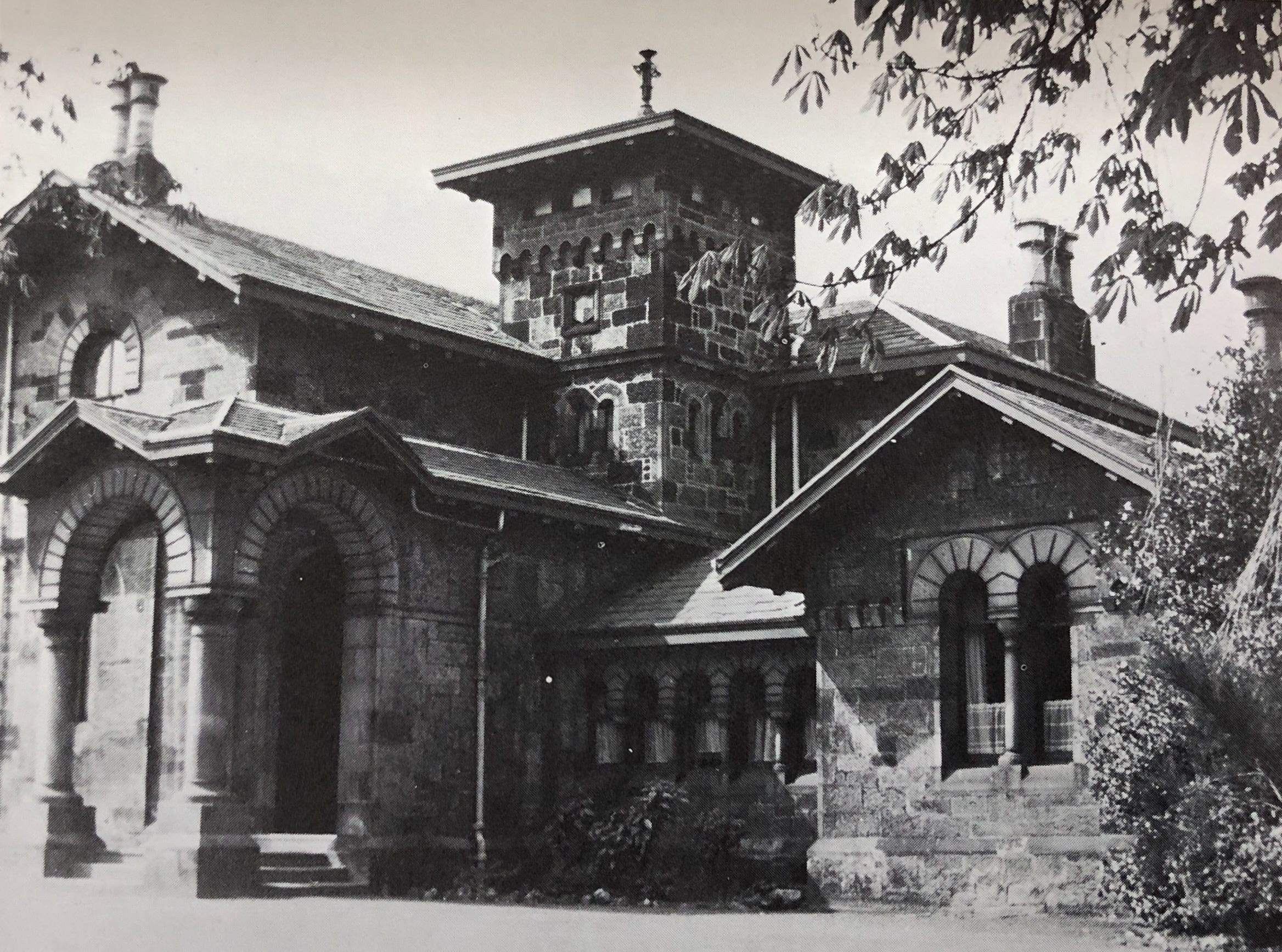
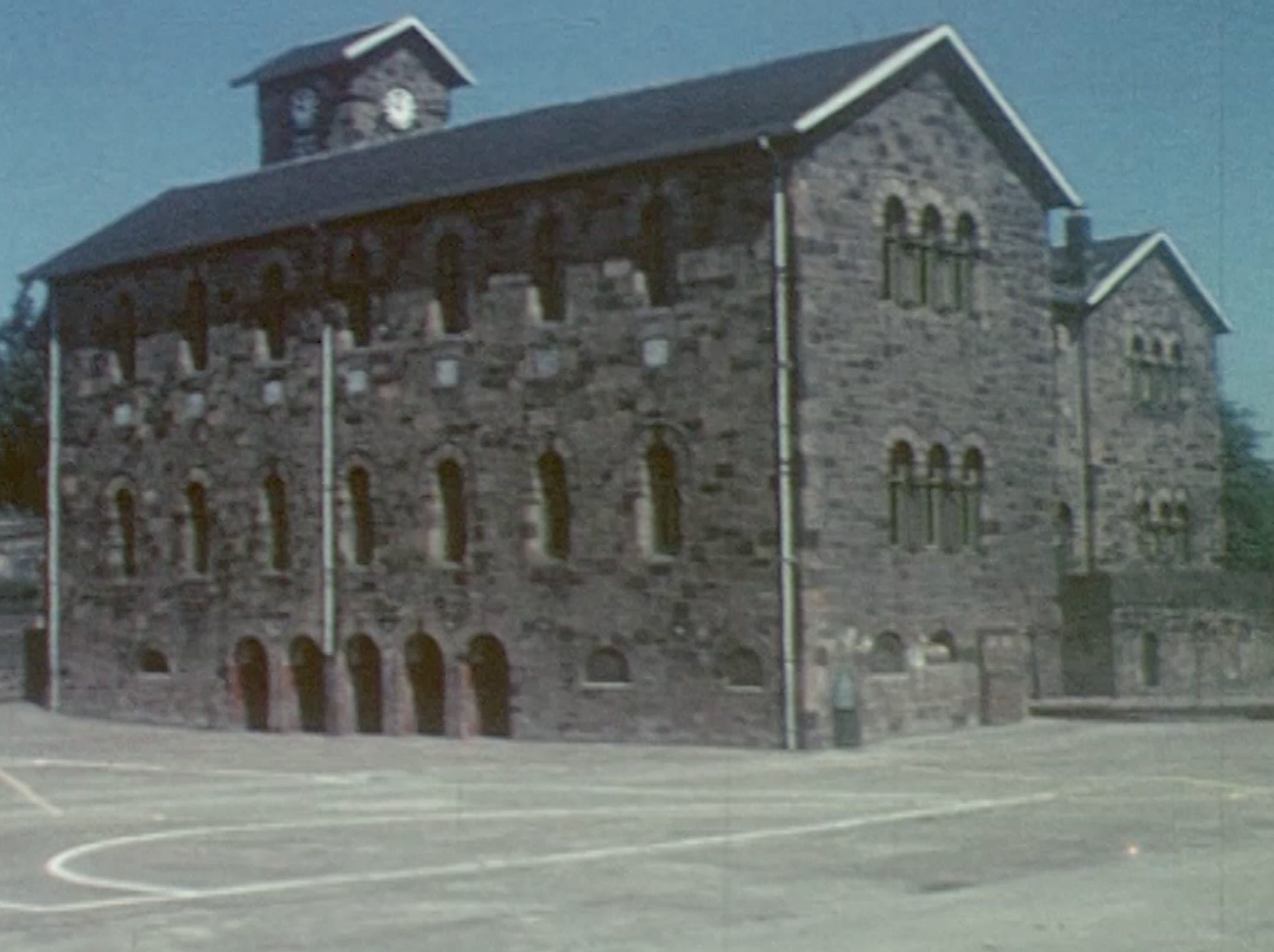
Perhaps a collapse occurred while this was under construction, since after The Knowe, the evidence of the arch as a significant feature is for Pollok Academy of 1855. Perhaps this was more Baird than Thomson, since Rockland of 1854 and Greenbank of 1855 omit arches entirely.
At the end of his fourth lecture, Thomson comments on his original lecture plan:
When I began these lectures my intention was to restrict them to three – the first on art in general, the second on the origin of architecture and the ancient architectural styles; and the third on the mediaeval styles, the present practice, and what we should aim at for the future. But the lectures have extended to four, and three of them have been devoted to matters which, according to the original plan, were all to have been overtaken by the second…. In the third lecture we witnessed the laws of architecture carried to the very highest degree of development to which they have hitherto attained, by the Greeks, who aimed at achieving excellence in all that they attempted. In the present lecture we have followed architecture in its decline through the Roman period, and have been brought to the very verge of the dark valley which separates the ideal and intellectual glories of the ancient world from the vigorous expression of life in the Middle Ages – and here, for the present, we must stop.
The Light of Truth and Beauty, Glasgow 1999
Karl Richard Lepsius (1810–1884), a German Egyptologist, linguist and archaeologist, best known for his twelve-volume Denkmäler aus Ägypten und Äthiopien (Monuments from Egypt and Ethiopia) of 1849